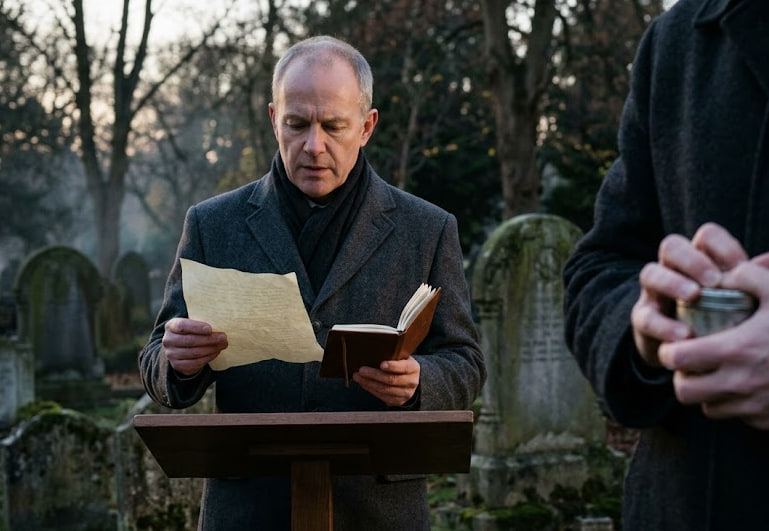
The cemetery had fallen completely silent.
Even the distant traffic seemed muted, as though the city itself had stepped back to listen.
I felt my fingers tighten around the small metal tin Clara had given me.
My heart was pounding.
Not because I expected money.
Not because I expected some dramatic revelation.
Because for the first time since I had met Clara Thompson, I was hearing words she had never managed to say while she was alive.
Mr. Reeves continued reading.
“Daughter,
By the time this letter reaches you, I will no longer be here to explain any of this myself. That is my greatest regret.
The truth is simpler than you may imagine.
I did not know about you when you were young.
I knew of your existence, but not where life had taken you.
Years ago, circumstances, misunderstandings, and decisions made by frightened people created a separation that should never have happened.
For many years, I believed there was no way to repair it.”
The lawyer looked up briefly before continuing.
“I searched for answers later than I should have.
That failure belongs to me.
No one else.
When I finally found you, I was afraid.
Afraid that appearing suddenly in your life as a stranger claiming connection would cause more harm than good.
So I did the only thing I could think to do.
I created a reason to see you every week.”
A murmur passed through the small crowd.
My eyes filled with tears.
Twenty dollars.
The bread.
The oatmeal.
The criticism about the windows.
The baseboards.
All of it.
Not charity.
Not coincidence.
A woman trying to build a bridge one Thursday at a time.
The lawyer continued.
“At first, I told myself I only wanted to know whether you were happy.
Then I wanted to know whether you were kind.
Then whether you were strong.
The answer to all three questions was yes.
You reminded me every week that character is not measured by wealth, education, or social standing.
You arrived tired and worried, yet treated every person with dignity.
You cared for your mother without complaint.
You worked harder than anyone had a right to expect.
And somehow you remained hopeful.”
I could barely breathe.
Across the gathering, I noticed Matthew looking down at the ground.
For the first time, he seemed genuinely uncomfortable.
Not defensive.
Ashamed.
The lawyer turned another page.
“Please understand something important.
You never cleaned my house because I needed help with the floors.
You cleaned my house because I needed help with my heart.
Every Thursday, for a few hours, I was allowed to know my daughter.
Not as an idea.
Not as a regret.
As a person.”
A tear slipped down my cheek.
I didn’t bother wiping it away.
Neither did several others standing nearby.
Even strangers were listening now.
Listening to a woman speak across the distance between life and memory.
The letter continued.
“I know you may feel angry.
You have every right.
You may feel confused.
You have every right to that as well.
But I hope, eventually, you will understand something.
The greatest gift of my life was not finding you.
It was discovering that the woman you became was already extraordinary without anything I could have given you.”
The lawyer folded one page and opened another.
This section was shorter.
More practical.
“I am leaving my home to be sold.
A portion of the proceeds will establish a community scholarship fund for young caregivers—people who spend their lives helping others while putting their own dreams on hold.
Ana will oversee the selection committee if she chooses.
Not because she owes me anything.
Because she understands the value of opportunity.”
My eyes widened.
A scholarship fund.
Not an inheritance built on luxury.
A chance to help others.
It sounded exactly like Clara.
Practical.
Purposeful.
Focused on people rather than possessions.
Then came the final paragraph.
“Daughter,
For months I searched for the perfect moment to tell you everything.
I kept waiting.
Then I realized something.
Life does not guarantee perfect moments.
It only gives us the courage to use the imperfect ones.
I should have told you sooner.
For that, I am sorry.
But please know this:
You were loved before I met you.
You were loved while I knew you.
And you will be loved long after I am gone.
Thank you for every Thursday.
With all my love,
Clara.”
The lawyer lowered the letter.
Nobody spoke.
For several long moments, the only sound was the wind moving through the trees.
I stared at the grass beneath my feet.
Twenty dollars.
A piece of bread.
A bowl of oatmeal.
Three hours every Thursday.
That was all it had looked like from the outside.
But from Clara’s side, it had been something entirely different.
A second chance.
A relationship built carefully, quietly, one ordinary afternoon at a time.
Later that day, after the formalities ended and people began leaving, I remained near the cemetery gate.
Matthew approached hesitantly.
His shoulders seemed smaller than before.
Older somehow.
“There are things I should have said years ago,” he said.
I waited.
“My mother spent a long time regretting missed opportunities.”
His voice cracked slightly.
“When she found you, she was happier than I’d seen her in years.”
I looked at him carefully.
“Why didn’t she tell me?”
He smiled sadly.
“Because she was terrified you’d walk away.”
That answer hurt because I understood it.
Not because it was irrational.
Because it was human.
We all fear rejection.
Even the people who seem strongest.
Especially them.
Months later, after the estate was settled, the scholarship fund officially launched.
Applications arrived from students caring for parents, grandparents, younger siblings.
Young people balancing responsibility and ambition.
People who reminded me of myself.
Every year, we awarded assistance to those who needed it most.
Every year, I thought about Clara.
Not the wealthy homeowner.
Not the mysterious woman with impossible standards for clean windows.
The woman who left bread on the table and pretended it wasn’t kindness.
The woman who taught me that family is sometimes built in unexpected ways.
Today, the photograph she left me sits in a frame above my desk.
In it, Clara is younger.
Laughing.
Looking away from the camera.
Whenever I see it, I remember something important.
The things that change our lives are rarely dramatic.
Sometimes they arrive disguised as ordinary Thursdays.
Sometimes they look like a small kitchen table.
A piece of bread.
A twenty-dollar bill.
And a person who sees your worth long before you see it yourself.
In the end, Clara did leave me an inheritance.
But it wasn’t money.
It wasn’t property.
It wasn’t even the scholarship fund.
It was certainty.
The certainty that I had been seen.
That I had mattered.
That somewhere, behind every criticism about baseboards and every complaint about streaked windows, there had been love.
And that changed everything.
